“… the concept of betraying one’s race through sex and sexual politics is as common as corn”

I take a running jump from the
imaginary precipice and BAM, I collapse to my knees on the laminate flooring
all while yelling “GERONIMOOOOO” at the top of my lungs. I raise my head and
see my fellow group members beaming and applauding. From down the hall I can
hear snippets of laughter, definitely my roommate and her boyfriend making fun
at the expense of my poor knees (SHUT UP! The right one has had reconstructive
surgery).
Why did I throw myself so unceremoniously
in the tiny confines of my living room, in front of a small audience no less?
Well, the neighbours in the apartment below mine are CONSTANTLY playing loud
music and electric guitar. I figure if I throw all my weight to the floor once
in a while, it should remind them that I am not nearly as annoying as them and
they should pipe down more often. As effective as this strategy sounds, in
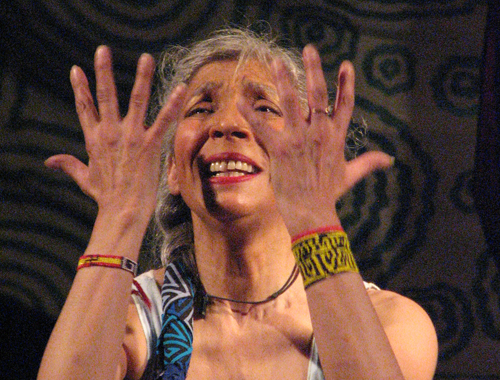
actuality I did it because I was performing the opening scene from Monique
Mojica’s play Princess Pocahontas and the
Blue Spots. My fellow bloggers and I spent the better part of two hours
reading this play aloud and taking turns performing scenes, or as Mojica dubs
them, “Transformations.” In the ten “Transformations,” the play weaves the
journeys taken by Contemporary Woman #1 and Contemporary Woman #2 with the
stories and histories surrounding four prominent indigenous women or groups of
women in the early onset of colonialism in the New World: La Malinche, partner
to Hernan Cortez (the Spaniard who invaded Mexico), the Woman of the Puna/Deity/Virgin
of colonial Peru, the First Nations wives of the fur traders in Canada and Pocahontas/Matoaka/Lady Rebecca
and the settlers at Jamestown Virginia.
 In the first transformation, I was
acting the role of Princess Buttered-on-Both-Sides, a contestant of the fictitious
and satirical “500 Years of the Miss North American Beauty Pagent,” and
illustrating the character’s undying love for John Whiteman (more commonly
known as Smith) by throwing myself into Niagara Falls, which, in this case is my
living room floor.
With characters like the “Blue
Spots” and “Princess Buttered-on-Both-Sides” saying lines such as: “you’re the
cheese in my fondue” and “be my muffin, I’ll be your marmalade”, it seems like
a random assortment of weird characters and their phrases, instead, these
coalesce to evince the brilliance and wit of Mojica. In the opening
Transformation, Princess Buttered-on-Both-Sides tells her audience, “I shall
dance for you in savage splendour, the Dance of the sacrificial Corn Maiden”, demonstrating
the playwright’s innate ability to frame the ahistorical and normative
understandings of indigenous women as both ridiculous and with humorous
exaggeration; an effective tactic in compelling the audience to consider the alternative,
or to simply question the history and stereotypes spoon-fed through Disney, pop
culture and reinforced through biased and complacent education systems.
As Shari Hundorf argues in her
reflection of Mojica as a playwright- the idea that indigenous women were in
love with white men and played a role in facilitating their settlement of the
New World, the onus of settler guilt is reduced, if not removed. The indigenous
man is still regarded as a fierce warrior, defending his nation and fighting
the threat to the way of life he knows and loves, while his female counterpart
must carry the blame and shame for her role in destroying it. Further, because
indigenous women are the exotic “other” to the white man but also possess the
ability to reproduce future generations of non-settlers, or children of mixed
blood, they are seen as threats and deserving of objectification, be it sexual
or violent to settler men- these same men who benefited from the brokerage of
peace arranged by the indigenous woman.
This interpretation is dangerous on
many levels and the prevalence of this perspective is reflected by the current
status and treatment of Aboriginal women in North America, one of the worst
demographics in nearly every category: suicide rates, health, incarceration,
physical and sexual abuse, etc. While many are aware that the situation for our
First Nations women is dire, it is through song, dance, dialogue and monologue
that Mojita’s characters impose a historical lens that forces the audience to re-examine
our popular notions of who indigenous women are, and where this popularization
came from.

Indigenous women (and men) have a
history where colonialism tried to destroy them, and this trend remained and
continues to be perpetrated in settler society. As Jessica Danforth points out,
“this can be uncomfortable to the settler.” She’s right. As a feminist, a settler
and a student I am willing and
wanting to learn about the ‘legacy’ that
is colonialism, but having to come to terms with the fact that my settler and
white privilege came to be because it was ripped away from someone who was
indigenous – is undoubtedly
uncomfortable. Reading and acting out Mojica’s Princess Pocahontas and the Blue Spots provided this medium for
which I felt more comfortable challenging my discomfort as a settler. Mojica’s
sarcasm and wit, interlaced with powerful stories of the indigenous women
dealing with the front lines of colonialism in the contact period prompted me
to revaluate and reflect on all the ahistorical and mainstream media infused
perspectives on indigenous women, but it also allowed me to laugh.



No comments:
Post a Comment